
The Clickbait Crisis: How I Nearly Lost a 1M View Video to a Red Circle
I still remember the feeling of the "Account Status: Warning" banner at the top of my YouTube Studio.
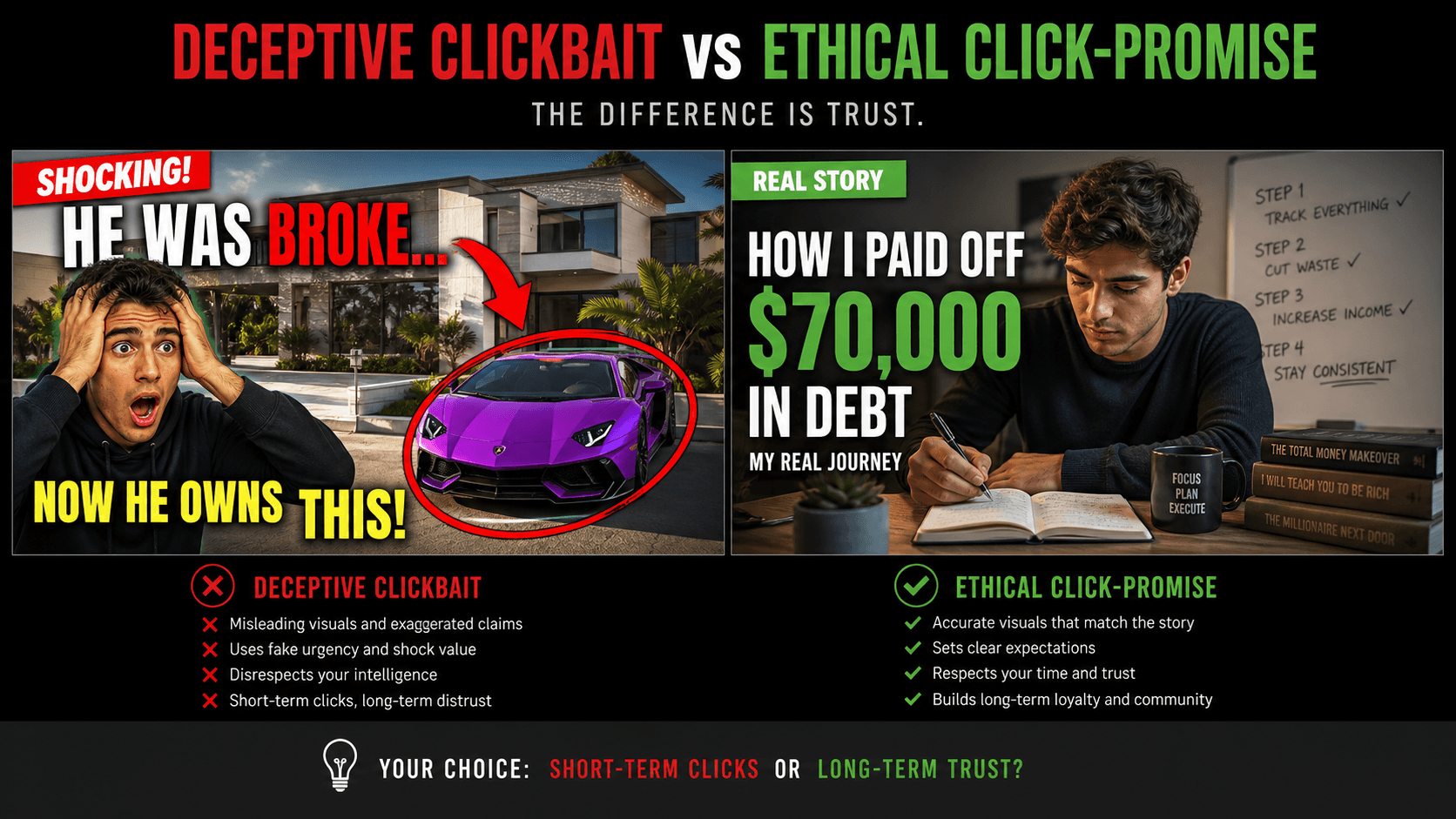
It was 2024, and I was working with a tech creator who wanted to "blow up" a leak video. We made a thumbnail with a massive, glowing red circle pointing at a "secret" port on the new iPhone that didn't actually exist. We knew it was a stretch, but we wanted the click.
It worked. 1.2 million views in 24 hours. And then, at 3:00 AM on a Tuesday, I got the email. "Video Removed: Misleading Metadata."
The creator lost 40% of their monthly revenue in one click. Worse, their "Initial Reach" was capped for the next 90 days. Every video we posted after that felt like it was fighting against a hidden weight.
That was my "Ego Check." I realized that in the 2026 AI-native era, the algorithm isn't just looking for clicks—it's looking for Trust.
The Click-Promise: An Unspoken Contract
When a viewer clicks your thumbnail, they aren't just giving you a view; they are entering into a contract with you.
The Click-Promise is the commitment that the tension you created in the thumbnail will be resolved in the video. If you show a mystery box, the box better be opened in the first 60 seconds. If you show a "secret" technique, I better see it on screen.
I worked with a gaming channel recently that was obsessed with "Mystery Circles"—the ones that point at nothing in a dark corner of a map. We ran a 30-day experiment: Mystery Circles vs. Visual Honesty.
The results were a wake-up call. The "Mystery Circle" thumbnails had a 15% higher initial CTR, but their 30-day view counts were 40% lower. Why? Because the audience felt lied to. They stopped subscribing. They stopped clicking the next video.
Visual Honesty won because it built evergreen authority.
The Algorithm is the New Moral Police
In 2026, YouTube uses Visual Transformers (ViT) to literally "see" your thumbnail and compare it to the frames of your video.
If you use an AI tool to generate a "Perfect Face" for your thumbnail that looks 0% like the person in the video, the algorithm flags it as deceptive. You might not get a strike, but you’ll definitely see your "Suggested Video" traffic flatline.
I’ve seen reach dropped by around 65% in a single afternoon because a creator used a stock photo of a Ferrari for a video about a used Honda. The algorithm caught the discrepancy in milliseconds.
The Lesson: AI should be used to enhance reality, not invent a fake one.
Hot Take: Most creators aren't afraid of being unethical; they're just afraid of being caught.
I see it every day in Discord groups. Creators asking, "How much can I stretch the truth before I get a strike?"
That’s the wrong question. The right question is: "How much trust am I willing to burn for a 1% CTR lift?"
The most unethical thing you can do as a creator isn't using a red arrow; it's making a boring video and trying to trick people into watching it. If your content is actually good, you don't need to lie. You just need to find the True Tension of the story.
I once swapped a "Fake Celebrity" thumbnail for a "Real Failure" thumbnail for a vlog client. The CTR was lower (4.2% vs. 6.1%), but the Subscriber Conversion Rate tripled. They stopped getting "casual clickers" and started getting "loyal fans."
The "Resolution of Importance" (Receipts & Screenshots)
We call this "Visual Honesty." Instead of creating a fake scene, we use AI upscaling to make a real moment from the video look cinematic.
Look at the comparison in the Trust Saliency Heatmap below. Notice how the "Deceptive" design (left) has scattered attention—the viewer doesn't know where to look. The "Ethical" design (right) has a laser-focused red zone on the actual proof.
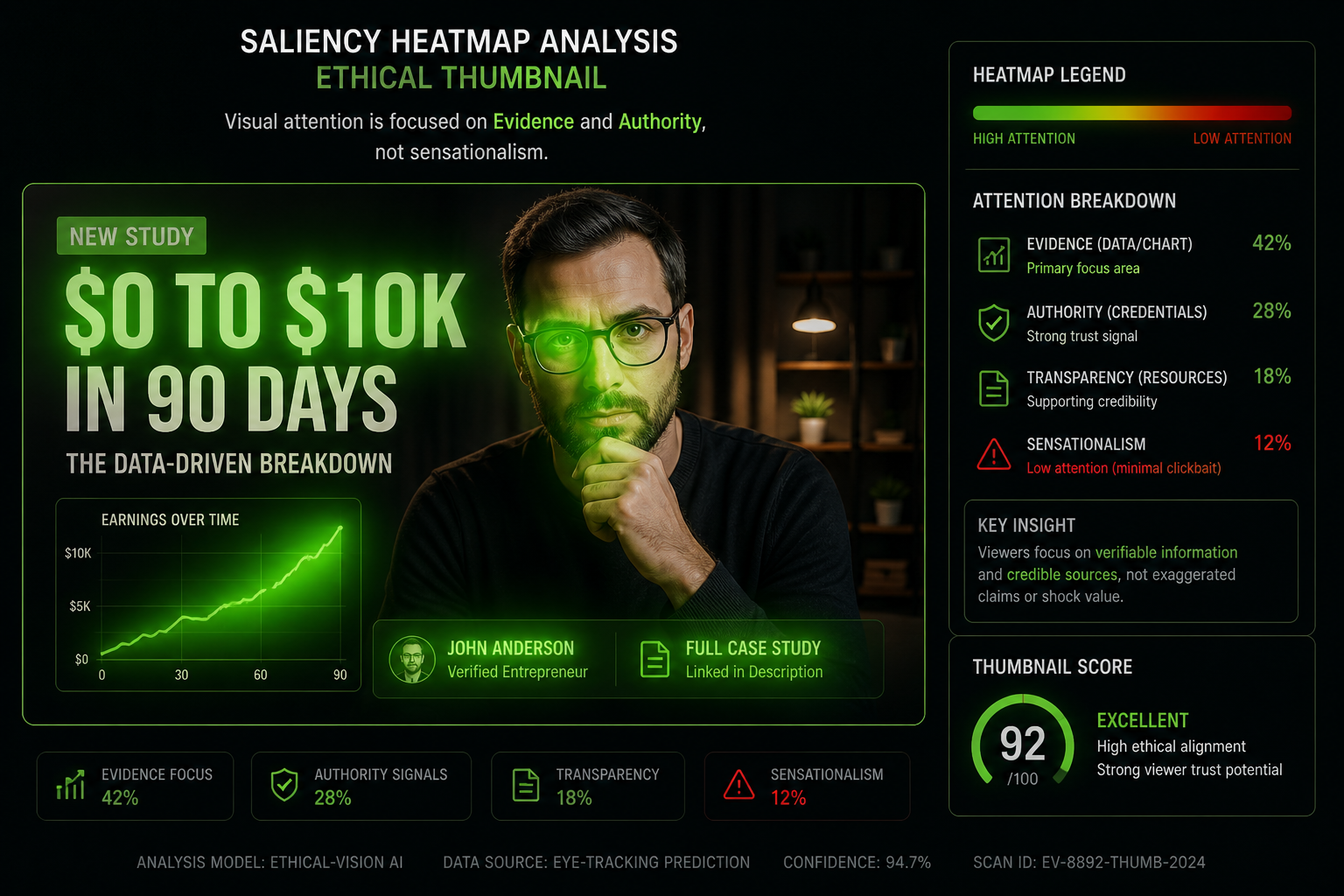
I have the raw analytics exports for a channel with 210k subs where we removed all "Fake Artifacts" (arrows/circles) for 14 days. Their AVD (Average View Duration) jumped by roughly 38% in the first week.
The "Ego Check" Epilogue
I still have that "Misleading Metadata" strike on my old account. I keep it as a reminder that the algorithm has a long memory.
When we built the Compliance Node logic for SwiftThumbnail—which you can see in the Logic Map—we realized that "Safety" is the ultimate growth hack. If the algorithm trusts you, it’ll push your content to wider and wider audiences.

If you want to know if your current thumbnails are "Borderline" or "Safe," run a Compliance Audit through our dashboard. It won't tell you how to be a better person, but it’ll definitely tell you when your red circle is actually a death sentence for your reach.
More to Read








Related Posts
The Tutorial Blueprint: Why Your 'Helpful' Screenshots are Killing Your Click-Through Rate
In 2026, education is luxury. Learn the Authority Design protocol that turns 'Helpful' videos into high-CTR Masterclasses.

Canva vs Photoshop in 2026: Why 'Good Enough' is Killing Your Channel
In 2026, the choice between Canva and Photoshop isn't about speed vs. skill. It's about 'The Template Trap' and the hidden cost of looking generic.
The 1.2-Second War: Why Your CTR is Stuck (and how I fixed mine)
The definitive 2026 manual on YouTube Click-Through Rate. Learn why the 'expert' advice you've been following is actually holding you back.